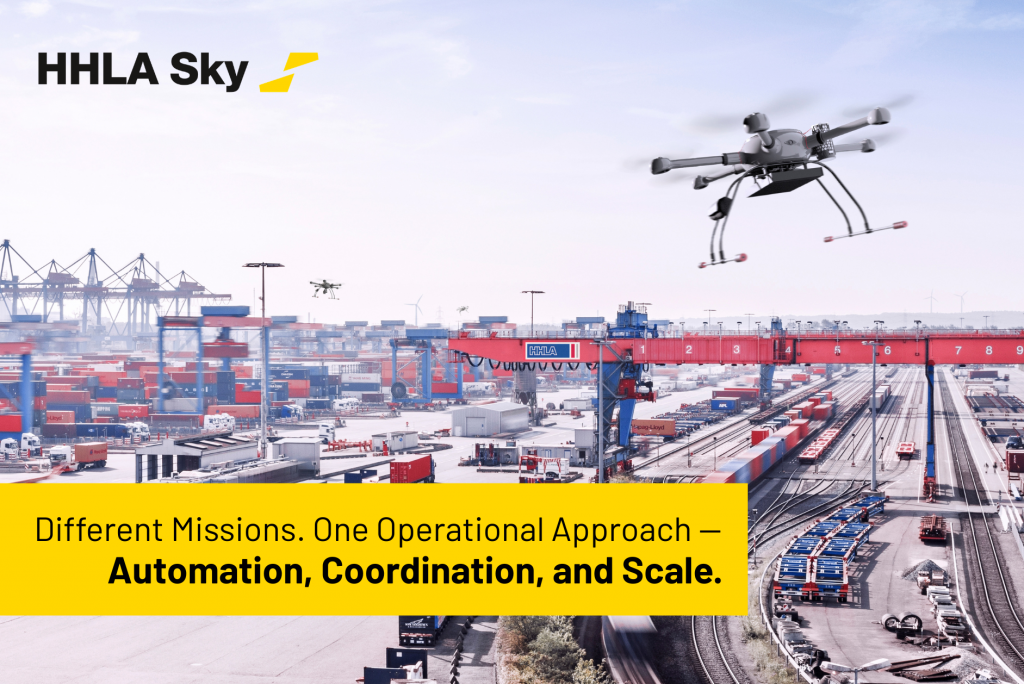
The “one pilot, one drone” model has become a critical bottleneck for modern industry. In a world where labor shortages are projected to hit 85 million people by 2030, according to the World Economic Forum and global industrial efficiency must rise by 30% to meet demand, manual operations simply cannot scale. HHLA Sky transforms drones from isolated gadgets into a networked, automated workforce. By merging an Integrated Control Center (ICC) with Uncrewed Traffic Management (UTM), we enable 24/7 automated infrastructure that scales far beyond human limits.
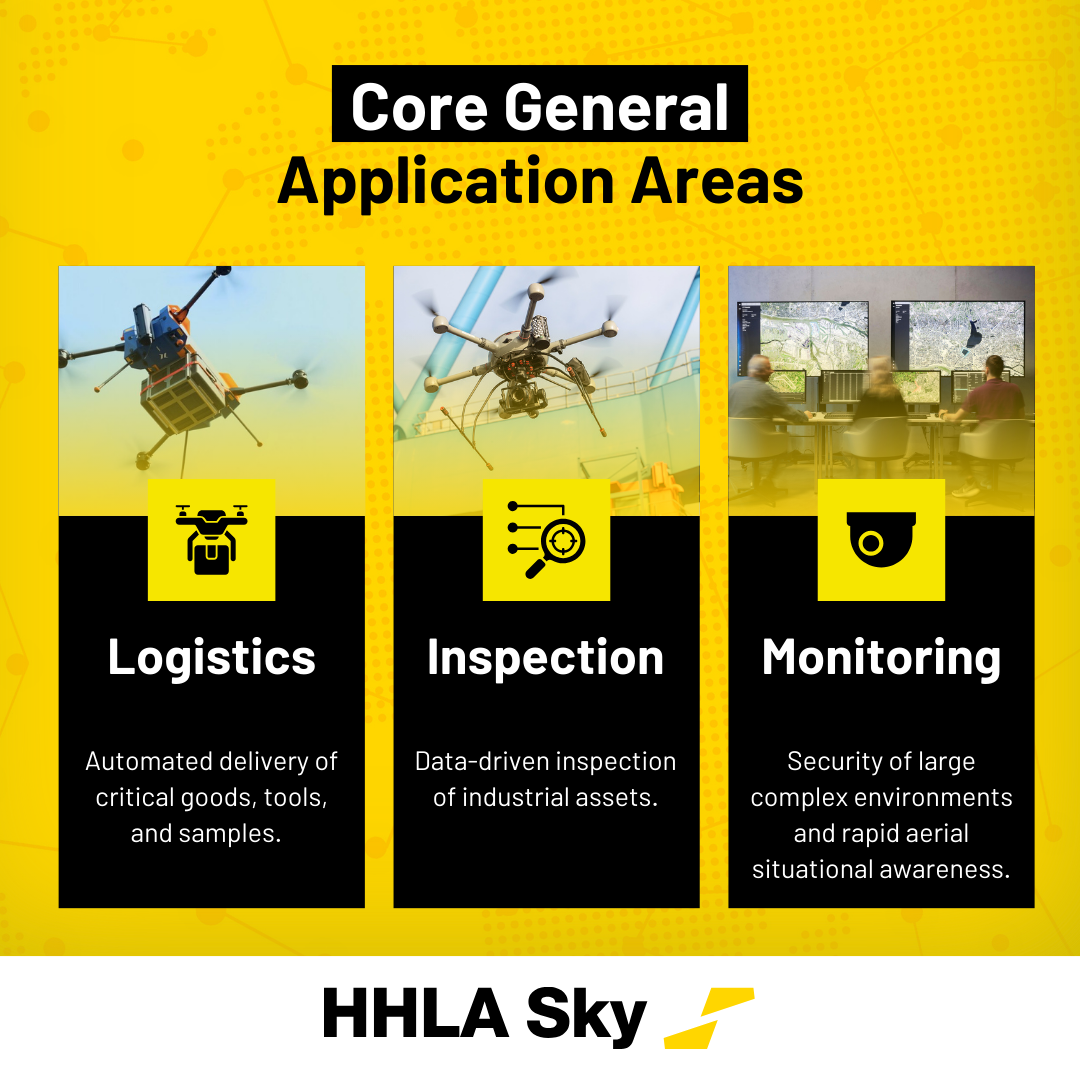
The inspection of vast, complex, or hazardous infrastructure has historically been a labor-intensive and dangerous endeavor. Traditional methods involving scaffolding, rope access teams, or mannedhelicopters incur significant costs and expose personnel to extreme risks. Furthermore, human-led inspections can be inconsistent, often leading to overlooked defects in critical structures.
HHLA Sky’s solutions redefine this function by moving the risk from humans to hardware. Within the ICC, engineers pre-program intricate flight paths for robust multi-rotor drones. These paths are generated with GPS, ensuring consistent data capture across repetitive inspections over months or years. The system integrates 3D models of the infrastructure, allowing for sophisticated collision avoidance mapping and optimized sensor positioning even in high-interference environments.
Drones can be equipped with high-resolution RGB cameras, alongside thermal imaging sensors, LiDAR scanners, and multispectral cameras. These payloads are gimbal-stabilized to provide distortion-free data in challenging wind conditions typical of ports or mountain ridges. The ICC facilitates Beyond Visual Line of Sight (BVLOS) drone operations, enabling drones to inspect large linear assets like pipelines and power lines that extend far beyond an operator’s view. Raw imagery is securely transmitted to cloud-based platforms where AI algorithms automatically detect anomalies, measure cracks, or identifycorrosion, reducing inspection times drastically.
The demand for faster and carbon-neutral logistics is escalating as congested urban environments and geographical barriers make traditional road transport slow and expensive. HHLA Sky provides a comprehensive framework for drone-based cargo transport, effectively creating a “drone airline” for the B2B sector.
The X25 octocopter and V25 VTOL fixed-wing aircraft provide versatile cargo capabilities tailored to industrial needs. The X25 and V25 handle payloads for quick and efficient operations making logistic process plannable.
For routine cargo flights between medical labs or industrial facilities, the UTM platform is indispensable in connection with the ICC. It manages flight authorizations within designated U-Space corridors, ensuring deconfliction with other air traffic and adherence to strict aviation regulations. This entire data chain, from mission planning to delivery confirmation, is secured under the IEC 62443 standard, ensuring that high-value or sensitive cargo is tracked with total digital integrity.
Securing large perimeters and high-value assets demands a level of vigilance that human patrols cannot maintain due to limited capabilities and line of sight. HHLA Sky’s autonomous drones and ground robots offer a persistent, intelligent surveillance shield that operates around the clock.
The ICC allows security managers to schedule regular, autonomous patrol flights along predefined routes. Drones are designed for rapid deployment and can cover vast areas that would take hours for a ground team to traverse. These aircraft are equipped with high-definition optical sensors and thermal cameras for night vision, allowing operations in a multitude of different conditions.
A unique technical advantage is the coordination between aerial and ground assets. If an airborne drone detects a perimeter breach through its onboard edge computing, the ICC can autonomously dispatch a Capra Hircus ground rover to the exact GPS coordinates for a closer look. This multi-modal response provides real-time situational awareness and robust evidence collection for incident investigation while significantly reducing the number of personnel required to secure expansive industrial sites.
When every second counts, access to immediate aerial intelligence is non-negotiable for saving lives and mitigating property damage. Traditional methods for assessing disaster zones like fires or industrial accidents are often too slow or dangerous for first responders.
HHLA Sky drones can be deployed within minutes of an alert. Pre-programmed emergency flight profiles can be activated with a single command from the ICC, sending drones to incident sites to provideimmediate tactical views. Thermal cameras are invaluable for identifying hot spots in structural fires or locating individuals trapped in smoky environments, while specialized gas sensors can detect hazardous chemical leaks to provide life-saving data for incident commanders.
The UTM platform plays a vital role in these complex scenarios by managing Temporary Flight Restrictions (TFRs). This ensures that autonomous drones do not interfere with manned rescue helicopters or other critical aircraft. Post-incident, the drones can rapidly create high-resolution 3D models of affected areas, which assists authorities in damage assessment, resource allocation, and long-term reconstruction planning.
Environmental monitoring and data collection
From assessing biodiversity to monitoring industrial pollution, drones offer an unprecedented platform for granular data collection that supports sustainable practices and regulatory compliance. Manual sampling in inaccessible areas like wetlands or remote coastlines is traditionally expensive and prone to human error.
Drones carry specialized sensors that capture data, allowing for precise analysis. The ICC enables the creation of repetitive flight plans to monitor environmental changes over time, ensuring that researchers have consistent, auditable data for trend analysis on issues like deforestation or glacial melt.
Furthermore, these drones can be equipped with miniature sensors to measure particulate matter and volatile organic compounds. Because the drones are electrically powered, they produce zero direct emissions and minimal noise, making them the ideal tool for monitoring sensitive wildlife habitats without causing disruption.
The true power of HHLA Sky’s solution lies in its ability to decouple the operator from the aircraft. The ICC allows a single employee to manage a fleet of over 100 drones globally, while the UTM platform ensures these drones integrate seamlessly with international aviation standards. From the demanding environment of the Port of Hamburg to the front lines of emergency response, HHLA Sky is demonstratingthat the future of industrial efficiency is taking flight through autonomous, centrally managed, and intelligent operations.